LED lights are now used across homes, offices, industrial facilities, commercial buildings, and outdoor environments. They are widely selected for their efficiency, durability, and long-term cost benefits. However, not all LED lights perform the same over time. While some continue to deliver stable brightness and color for years, others begin to dim, flicker, or fail much earlier than expected. These differences are rarely random.
The long-term behavior of an LED light is shaped by how carefully it is planned, built, and validated before it ever reaches the user. Design decisions, material choices, production accuracy, and quality checks all play a role in determining whether a light performs consistently or degrades prematurely. Understanding these factors allows buyers to look beyond upfront cost and evaluate lighting products based on real-world durability and value.
In India specifically, LED lifecycle performance is shaped by conditions that most globally-written content ignores: voltage swings between 90V and 300V, ambient summer temperatures exceeding 45 degrees Celsius in commercial spaces, monsoon humidity that accelerates corrosion, and dust infiltration in industrial environments. Understanding how engineering discipline addresses these conditions allows buyers to move beyond upfront cost and evaluate lighting products on real-world durability.
Why Indian conditions demand a different engineering standard
Most LED lifecycle content is written for temperate markets where ambient temperatures rarely exceed 30 degrees Celsius and grid voltage is stable. India is a fundamentally different operating environment.
These are the specific electrical and environmental stressors that a well-engineered LED product sold in India must be designed to handle:
- Voltage fluctuation: India’s grid routinely swings between 90V and 300V, particularly in Tier 2 and Tier 3 cities and in industrial zones. LED drivers not engineered for this range fail early or damage the chip.
- Ambient heat: Summer temperatures in Delhi, Rajasthan, and across central India regularly exceed 45 degrees Celsius. This directly raises the LED junction temperature, accelerating lumen depreciation.
- Monsoon humidity: Relative humidity above 85 percent during monsoon season increases the risk of PCB corrosion, driver failure, and connector oxidation in products not sealed and treated for these conditions.
- Dust ingress: Industrial and semi-urban installations face heavy particulate matter. Dust accumulation on heat sinks reduces thermal dissipation and shortens effective lifespan.
Gutwillen LED products are engineered specifically for these conditions. Our drivers are rated for wide-voltage input to handle grid fluctuation. Our thermal designs are validated at 45 degree Celsius ambient to ensure junction temperatures remain within safe operating limits.
What lifecycle performance means in real-world LED use
Lifecycle performance refers to how an LED light behaves from the moment it is first switched on until it reaches the end of its usable life. This includes how well it maintains brightness, how stable its color output remains, how efficiently it manages heat, and how reliably it handles electrical load over time. It also includes resistance to environmental conditions such as temperature fluctuations, humidity, dust, and vibration.
Many people assume that LEDs automatically last for years without issue. In practice, longevity depends on how effectively all components work together under everyday operating conditions. A product with strong lifecycle performance delivers predictable output year after year, without requiring frequent maintenance or replacement. This reliability is especially important in commercial, industrial, and infrastructure applications where lighting downtime can disrupt operations.
The standard measure of LED lifespan is the L70 or L80 rating: the number of hours at which the light still delivers 70 percent or 80 percent of its original lumen output. An L80 rating of 50,000 hours means the LED will still deliver at least 80 percent of its original brightness after 50,000 hours of use, under the test conditions specified.
Products developed with proper engineering discipline are designed with real usage scenarios in mind rather than ideal laboratory conditions. This approach helps ensure consistent performance across a wide range of environments and use cases.
BIS certification and Indian standards: what they mean for lifecycle
In India, the Bureau of Indian Standards (BIS) certification under IS 16102 is the mandatory quality standard for LED lights sold in the domestic market. BIS certification requires that LED products pass defined tests for electrical safety, photometric performance, and thermal characteristics before they can be legally sold.
However, BIS certification is a minimum threshold, not a performance guarantee. Many products that pass BIS testing are manufactured to the absolute minimum standard required to achieve certification. The difference between a BIS-compliant commodity LED and an engineering-disciplined LED lies in what happens beyond the certification threshold.
Gutwillen products carry BIS certification under IS 16102. More importantly, our engineering process sets internal performance targets that exceed the BIS minimum requirements, particularly around thermal performance and driver stability under wide-voltage input conditions.
Design, thermal control, and component compatibility
Durable LED lighting begins with thoughtful design. Early-stage planning must account for electrical balance, optical efficiency, heat flow, and material interaction. Poor decisions at this stage can create long-term issues that only become visible after months or years of operation.
Heat management is one of the most critical factors affecting lifespan. Although LEDs generate less heat than traditional lighting technologies, the heat they do produce must be dissipated effectively. If heat accumulates around the LED chip or driver, it accelerates degradation and shortens usable life. Well-designed thermal paths, appropriate heat-sink materials, and proper airflow allow heat to dissipate quickly and safely.
Gutwillen LED panels are designed to maintain junction temperatures below 65 degrees Celsius even when operating in an ambient environment of 45 degrees Celsius, which reflects the real summer conditions in Indian commercial and industrial spaces. This is achieved through the combination of specific heat-sink geometry, aluminium alloy selection, and driver placement that minimises heat transfer between the driver and the chip.
Component compatibility is equally important. LED lights consist of chips, drivers, capacitors, lenses, wiring, and housing materials. Even high-quality components can fail prematurely if they are not suited to the operating environment or if they interact poorly with other parts. A disciplined design process ensures that each component supports the others, reducing stress and improving long-term stability.
Manufacturing accuracy, testing, and consistency
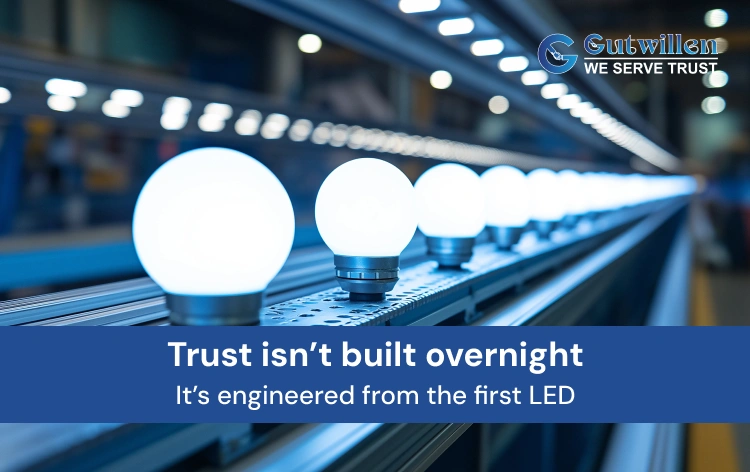
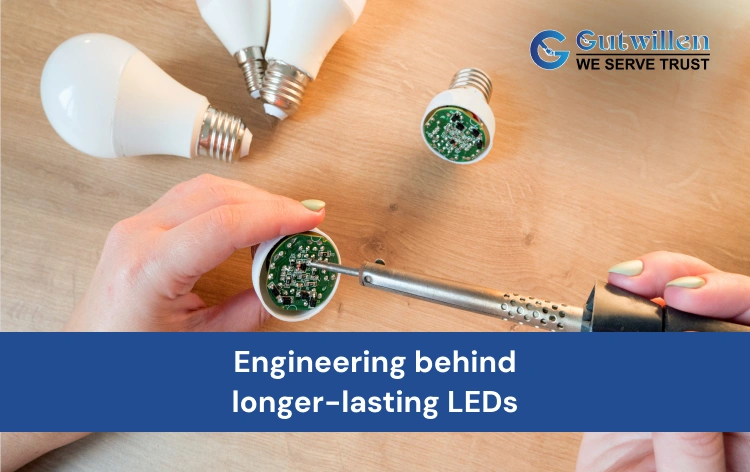
A strong design must be supported by precise manufacturing, which can only be achieved by an experienced LED bulb manufacturer. Accuracy during assembly, soldering, and alignment ensures that the final product reflects the original design intent. Small inconsistencies, such as weak solder joints or minor misalignments, may not be noticeable at first but often become failure points over time.
Testing plays a vital role in validating long-term performance. Thermal cycling, electrical stress tests, extended burn-in tests, and environmental exposure tests help reveal how LEDs behave after prolonged use rather than only when new. These tests identify potential weaknesses and allow refinements before products reach customers.
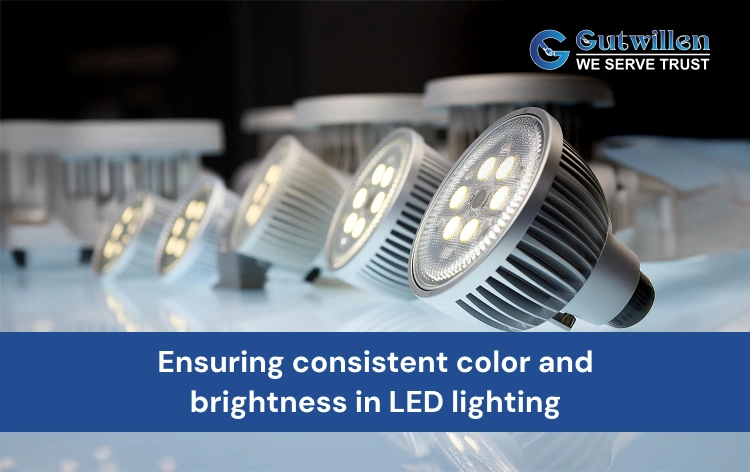
Consistency across production batches is critical for large commercial or infrastructure installations. A building fitted with LED panels from multiple production batches should deliver uniform colour temperature and lumen output throughout.
What to ask your LED supplier about lifecycle before you buy
Most LED buyers in India make purchasing decisions on price per unit and watt rating. Neither tells you anything about lifecycle performance. Here are the specific questions that will reveal whether a supplier’s claims are real:
- What is your L70 or L80 lumen maintenance rating, and at what ambient temperature and drive current was it tested?
- What is your driver’s input voltage range? Can it handle 90V to 300V input?
- What is your pre-shipment failure rate on electrical stress testing?
- Are your products BIS-certified under IS 16102? Can you share the certificate number?
- What is your heat-sink material, and what junction temperature does your LED chip operate at in a 45-degree Celsius ambient environment?
- What is your batch-to-batch colour consistency specification, and how do you measure it?
- Do you have any data from real installations in India covering twelve months or more of operation?
If a supplier cannot answer these questions with specific numbers, their lifecycle claims are marketing, not engineering.
Why long-term performance depends on process and mindset
Lifecycle performance directly affects the total cost of ownership. Lights that fail early or degrade quickly lead to higher maintenance costs, more frequent replacements, and increased downtime. Even if they are cheaper upfront, they often become more expensive over time.
A simple cost comparison illustrates this. Assume a commercial facility installs 100 LED panels across a 3,000 square metre space. A commodity LED at a lower unit price that requires replacement after 20,000 hours will incur replacement material costs and the labour cost of the replacement. An engineering-disciplined LED rated to 50,000 hours eliminates two replacement cycles over the same period. In a commercial installation with electrician labour costs, this difference becomes significant.
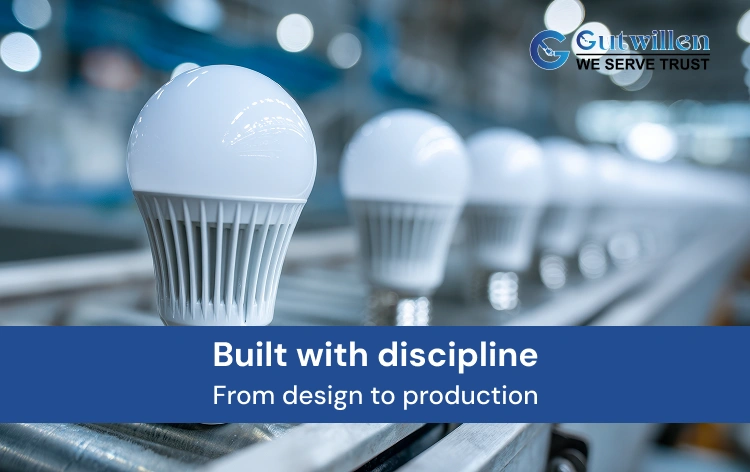
A disciplined approach to product development helps reduce these hidden costs by extending usable life and maintaining consistent performance. Engineering discipline encourages careful analysis, documentation, and continuous improvement, allowing teams to learn from real-world feedback and refine future designs.
Conclusion
The lifecycle performance of LED lights is determined long before installation. Design decisions, heat management, component selection, manufacturing accuracy, and testing collectively shape reliability.
For buyers in India, the standards are clear: BIS certification under IS 16102, drivers rated for 90V to 300V input, thermal designs validated at 45 degree Celsius ambient, pre-shipment testing with a sub-0.3 percent failure rate, and lumen maintenance ratings with transparent test conditions. These are not aspirational targets. They are engineering requirements for the Indian operating environment.
Gutwillen manufactures LED lights with a strong focus on disciplined processes that support consistent output and long-term durability. Built on proven German engineering principles, our manufacturing approach emphasises precision, quality control, and reliable component selection to ensure stable performance and extended product life across commercial and industrial applications in India.
To learn more about how this approach improves LED performance, or to explore suitable lighting solutions for your project, contact us today.
FAQs
1. Why does engineering discipline matter for LED lights lifespan?
Engineering discipline ensures that LED lights are designed to operate within safe electrical and thermal limits over time. Careful design, component selection, and testing reduce stress on critical components, helping maintain brightness, color stability, and overall reliability throughout the product’s usable life.
2. How does heat affect the lifecycle performance of LED lights?
Heat directly impacts how quickly LED components degrade. In India, where ambient temperatures can exceed 45 degrees Celsius in summer, an LED junction temperature that would be acceptable in Europe can become a serious lifecycle problem. Poor heat dissipation accelerates lumen loss and shortens driver life. Engineering discipline addresses this through heat-sink geometry, material selection, and driver placement that keeps junction temperatures within safe limits even in peak summer conditions.
3. What does BIS certification mean for LED lifecycle in India?
BIS certification under IS 16102 is the mandatory Indian standard for LED products. It establishes minimum thresholds for electrical safety, photometric performance, and thermal characteristics. However, BIS certification is a floor, not a ceiling. Engineering-disciplined manufacturers set internal performance targets that exceed BIS minimums, particularly for thermal management and wide-voltage driver performance.
4. Do higher-quality components always guarantee better LED performance?
High-quality components are important, but performance also depends on how well they integrate. Engineering discipline ensures compatibility across the system, accounting for voltage variation, temperature changes, and long-term stress. Without this integration, even premium components can fail prematurely.
5. What is an L70 or L80 rating and why does it matter?
L70 and L80 are standard measures of LED lumen maintenance. An L80 rating of 50,000 hours means the LED will still produce at least 80 percent of its original brightness after 50,000 hours of operation under the stated test conditions. These ratings matter because they give buyers a standardised, comparable measure of how long an LED will remain useful, rather than relying on vague claims about longevity.
6. What should I ask an LED supplier about lifecycle before buying?
Ask for the specific L70 or L80 rating with the test conditions, the driver input voltage range, the pre-shipment failure rate, the BIS certificate number, the junction temperature at 45 degree Celsius ambient, and the batch-to-batch colour consistency specification. If a supplier cannot provide these with specific numbers, their lifecycle claims are not based on engineering data.
7. How does manufacturing consistency impact long-term LED performance?
Manufacturing consistency ensures that every unit matches the intended design and performance standards. Engineering-led process control reduces variability, minimises defects, and helps maintain uniform performance across production batches, which is critical for long-term reliability and customer trust.