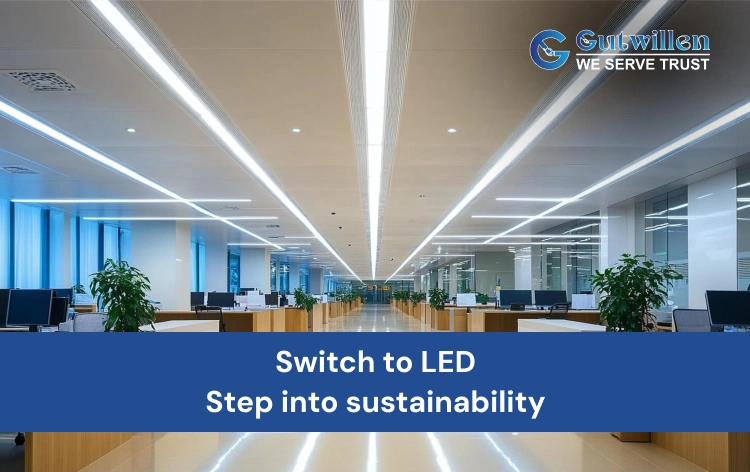

Electricity is a recurring operating expense that businesses cannot eliminate, but they can often reduce unnecessary consumption. Lighting is one area worth examining because offices, shops, warehouses, factories, hotels, hospitals, and other commercial properties may keep hundreds of fixtures running for several hours every day. Switching to LED lighting can lower electricity consumption, but there is no single savings percentage that applies to every business. The real financial benefit depends on what is being replaced, how long the lights operate, electricity tariffs, maintenance costs, and whether the new system is properly designed.
Rather than asking only how efficient an LED fixture is, businesses should calculate what the change means for their own property.
Why lighting costs can become significant for businesses
A single light may not appear to consume much electricity. Multiply that consumption by 50, 100, or 500 fixtures operating for eight to twelve hours a day, however, and lighting becomes a meaningful part of the electricity bill.
This is why commercial LED lighting decisions should begin with an inventory of the existing system. Businesses need to know how many fixtures they have, their wattages, daily operating hours, and how many days they operate annually.
Consider an office with 100 fixtures rated at 40W each. If they operate for 10 hours a day and 300 days per year, annual lighting consumption is:
100 × 40W × 10 hours × 300 days = 12,000 kWh
This figure provides a baseline against which a proposed replacement can be compared.
How to calculate savings from LED lighting
Suppose the same business can achieve its required illumination using 20W replacement fixtures. Under the same operating conditions, annual consumption would fall to:
100 × 20W × 10 hours × 300 days = 6,000 kWh
That represents an annual reduction of 6,000 kWh.
If the business pays ₹10 per kWh, the simplified electricity saving would be ₹60,000 per year. At ₹8 per kWh, it would be ₹48,000. At ₹12 per kWh, it would be ₹72,000.
These figures are examples rather than promised savings. Actual results depend on the existing and replacement systems, electricity tariffs, operating schedules, and whether the replacement provides suitable illumination.
This calculation also explains why percentage claims alone are not particularly useful. Two businesses installing identical fixtures can achieve very different financial savings because their operating hours and electricity costs may differ substantially.
Wattage alone does not tell you whether an upgrade will work
Reducing wattage is useful only if the new fixture still provides the light required for the space. Replacing a higher-wattage fixture with a lower-wattage product that leaves a workplace inadequately illuminated is not an effective energy-saving strategy.
Businesses should compare lumens as well as watts. Watts measure electricity consumption, while lumens indicate visible light output. Looking at the relationship between the two helps determine how effectively a product converts electrical power into useful light.
The requirements will also vary by application. A warehouse with high ceilings has different lighting needs from a small office, retail counter, corridor, parking area, or factory floor.
A successful LED lighting upgrade therefore starts with the required lighting performance and then looks for opportunities to achieve it with lower energy consumption.
Operating hours can change the financial case dramatically
One of the most overlooked variables is time.
Imagine two businesses with identical 100W fixtures. One operates them for three hours a day, while another operates them for twelve. Even if both install the same energy-efficient lighting, the second business has four times as many operating hours in which to generate electricity savings.
This is why businesses should prioritize fixtures according to actual usage instead of automatically replacing every light at once.
Reception areas, production floors, warehouses, corridors, parking facilities, and exterior areas that remain illuminated for long periods may deserve attention first. Rooms used only occasionally may produce a much smaller financial return.
Calculate payback, not just annual savings
Electricity savings are useful, but they do not tell businesses whether an upgrade makes financial sense.
Suppose a project costs ₹2,40,000 and is expected to reduce annual electricity expenditure by ₹80,000. Ignoring other costs and savings for simplicity, the basic payback period would be:
₹2,40,000 ÷ ₹80,000 = 3 years
A business can then compare that period with its budget, property plans, and investment priorities.
The calculation becomes more informative when maintenance is included. If the existing system requires frequent lamp replacements or servicing, those costs form part of the financial comparison too.
For facilities with hundreds of fixtures, reducing maintenance interventions may have considerable operational value, particularly when lights are installed at height or in areas that are difficult to access.
Maintenance costs deserve a place in the calculation
Businesses often calculate an upgrade based entirely on their electricity bills. That can underestimate the cost of continuing with an older system.
A better assessment includes the price of replacement lamps, labor, access equipment where necessary, and disruption caused by maintenance. These costs can be especially relevant in warehouses, factories, large retail properties, and outdoor commercial areas.
When evaluating LED lighting, businesses should compare expected maintenance requirements over several years rather than considering only the purchase price.
A product that costs less initially is not necessarily less expensive to own if it needs more frequent servicing or replacement.
Different areas may need different LED lighting solutions
A commercial property should not necessarily use the same type of fixture everywhere.
Offices may require comfortable and evenly distributed illumination. Warehouses can require LED high bay lights designed for higher mounting positions. Outdoor yards, building exteriors, and large open spaces may need LED flood lights with appropriate beam distribution and environmental protection.
Businesses should therefore assess lighting area by area. Important factors can include mounting height, lumen requirements, beam angle, color rendering, glare, environmental exposure, and operating temperature.
For outdoor products, ingress protection may also be relevant because fixtures can be exposed to dust and water.
This approach helps prevent a common mistake: choosing products primarily because their wattage is lower without checking whether their specifications suit the actual application.
Controls can create savings beyond fixture replacement
Changing fixtures addresses how much electricity each light consumes. Controls address how long it consumes electricity.
Occupancy sensors, timers, daylight-responsive controls, and scheduling can reduce unnecessary operating hours where appropriate. A storage room, meeting room, washroom, or low-traffic corridor, for example, may not require full illumination throughout the working day.
Similarly, outdoor lights may be controlled according to business hours and daylight conditions rather than relying entirely on manual switching.
Combining efficient fixtures with sensible controls can therefore produce a more complete energy strategy than replacing lights alone.
Which fixtures should a business replace first?
For businesses with limited budgets, replacing everything simultaneously may not provide the best use of available capital. A phased approach allows the areas with the strongest potential return to be addressed first.
Start with fixtures that combine high wattage with long operating hours. Next, identify areas with frequent maintenance requirements and spaces where existing illumination is poor or inconsistent.
Businesses can then rank each area according to annual consumption, potential energy reduction, maintenance cost, and upgrade expense.
This turns an LED lighting project into a measurable business decision rather than a general attempt to reduce electricity use.
Measure what happens after the upgrade
Savings calculations made before installation are estimates. Electricity bills and operating data after the project can show whether those estimates are being achieved.
Businesses should record what was replaced, the old and new wattages, quantities, operating hours, and installation dates. Comparing electricity consumption over appropriate periods can help determine whether expected reductions are appearing.
Changes in production, occupancy, weather, operating hours, and other electrical loads should also be considered. A lower lighting load does not automatically mean the total electricity bill will fall by exactly the same percentage.

Conclusion
The amount a business can save by switching to LED lighting cannot be reduced to one universal percentage. The strongest business case comes from comparing existing wattage, replacement wattage, operating hours, electricity tariffs, maintenance expenses, installation costs, and the lighting performance required in each area.
A simple fixture inventory and energy calculation can reveal where the biggest opportunities exist before money is spent. Businesses can then prioritize upgrades based on measurable savings rather than assumptions. For organizations considering more efficient lighting, Gutwillen offers lighting solutions for different commercial and industrial applications in India. Contact us today to learn more.
FAQs
1. How can a business tell whether LED lighting will deliver meaningful savings?
Start with the fixtures that operate for the longest periods and consume the most electricity. Calculate their current annual kWh consumption and compare it with suitable replacements. LED lighting is more financially meaningful when the reduction in annual electricity and maintenance expenses justifies the upfront investment within an acceptable period.
2. Should a business replace working lights or wait until they fail?
It depends on the economics. If existing fixtures consume significant electricity and operate for long hours, replacing them before failure may produce enough ongoing savings to justify the investment. For low-use areas, waiting until scheduled replacement may make more financial sense.
3. Can an LED upgrade reduce a building’s electrical load?
Replacing higher-wattage lighting with suitable lower-wattage alternatives can reduce the electrical demand attributable to lighting. However, the effect on the property’s overall electrical system depends on the scale of the project and other loads within the building.
4. Is the cheapest LED fixture likely to produce the highest savings?
Not necessarily. Purchase price is only one component of total cost. Businesses should also consider light output, efficacy, expected life, maintenance requirements, electrical characteristics, and suitability for the intended environment.
5. Should electricity tariffs be included when comparing lighting options?
Yes. Energy savings measured only in kWh do not show the financial impact. Applying the business’s actual electricity tariff makes the estimate more relevant and allows different upgrade options to be compared in monetary terms.
6. What records should businesses keep after completing a lighting upgrade?
Keep records of fixture quantities, previous and new wattages, installation costs, operating schedules, maintenance expenses, and electricity consumption. This information makes it easier to evaluate actual performance and plan future energy-efficiency projects.