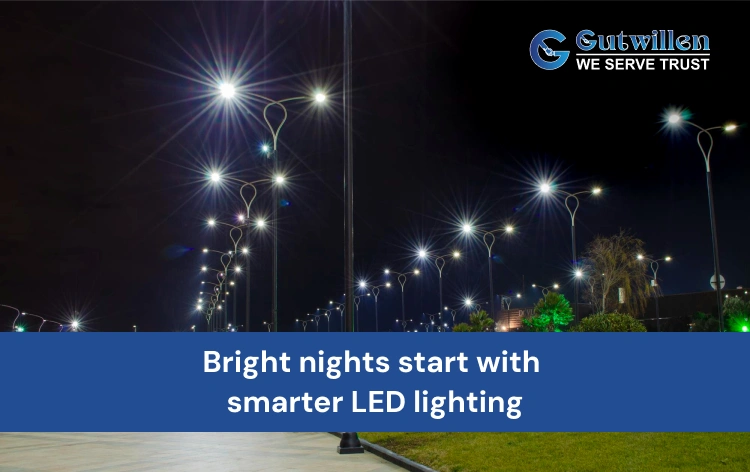
Choosing an outdoor light is not simply about picking the highest wattage available. A good LED street light should provide suitable illumination for the road or area, use power efficiently, and withstand the conditions in which it will operate. For Indian customers, especially in Delhi NCR, factors such as dust, heat, monsoon rain, road width, pole height, spacing, and maintenance access should all be considered before making a purchase.
Gutwillen’s product catalogue provides useful reference points through its G Visionedge Series, which includes 30W, 50W, and 100W LED street light models with different lumen outputs.
Why the right street light matters
Street lighting has to do more than make an area look bright. It should provide useful visibility where it is needed while avoiding unnecessary glare and excessive electricity consumption.
A common buying mistake is to compare products only by wattage. Wattage indicates electrical power consumption, while lumens indicate the amount of light produced. Two lights with different wattages may produce similar output, while two lights with the same wattage can perform differently depending on their design and efficiency.
The layout of the installation matters just as much. Pole height, distance between poles, road width, mounting angle, surrounding buildings, trees, and other obstructions can all affect how effectively light reaches the ground.
LED street light types and their applications
Street lights can be selected according to their output, design, mounting arrangement, and optical distribution. The right choice depends on what needs to be illuminated rather than simply choosing the biggest fixture.
Lower-wattage street lights
Lower-output fixtures can be useful for smaller roads, internal lanes, pathways, residential areas, and other locations where lighting requirements are moderate. Gutwillen’s G Visionedge 30W model is rated at 3,300 lumens, providing a useful reference point for this category.
Medium-wattage street lights
A 50W fixture can provide more output for applications that need wider or stronger illumination. Gutwillen’s G Visionedge 50W model produces 5,500 lumens and has an IP66 rating.
This type of fixture may be considered for residential society roads, internal roads, parking areas, commercial premises, and similar outdoor locations, depending on the lighting layout.
Higher-wattage street lights
For larger areas or applications requiring higher light output, a 100W fixture may be more appropriate. The G Visionedge 100W model is listed at 11,000 lumens and has an IP66 rating.
However, higher wattage should not automatically be treated as a better choice. If the area does not require the additional output, a higher-powered fixture can increase energy consumption without providing a meaningful improvement.
LED street light wattage chart
The following chart uses Gutwillen’s catalogue specifications as a practical reference. The suggested applications are general guidance and should not be treated as fixed installation rules.
| Wattage | Catalogue lumen output | Possible applications |
| 30W | 3,300 lm | Residential lanes, pathways and smaller internal roads |
| 50W | 5,500 lm | Society roads, parking areas and medium-sized internal roads |
| 100W | 11,000 lm | Wider roads, larger outdoor areas and commercial premises |
The three G Visionedge models share several specifications, including an operating voltage of 85-300VAC/50Hz, power factor above 0.95, CRI above 80, instant start, and IP66 protection. The listed operating temperature is -10°C to +50°C.
These specifications are worth checking when comparing products because outdoor fixtures have to deal with dust, moisture, electrical fluctuations, and changing temperatures.
Don’t select a street light by wattage alone
Wattage is only one part of the buying decision. Start by looking at the area that needs illumination. Measure the approximate road or open-area width and consider the height and spacing of existing poles.
Next, compare lumen output and the fixture’s intended application. If the light will be installed along a road, its distribution should work with the direction and layout of that road. For an open parking area or building compound, a broader distribution may be more useful.
Electrical specifications should also be considered. Gutwillen’s street-light models, for example, specify a power factor above 0.95, CRI above 80, instant start, and IP66 protection.
An experienced LED lighting manufacturer can help buyers understand these specifications in relation to the actual installation instead of treating wattage as the only selection criteria.
Street lights versus flood lights
Street lights and flood lights may both be used outdoors, but they serve different purposes. Street lights are generally selected for roads, lanes, and pathways where the direction and distribution of light are important.
Flood lights are more useful when a wider area needs illumination. They can be considered for building exteriors, parking areas, yards, industrial spaces, warehouses, and open compounds.
Gutwillen’s catalogue includes Econoray flood lights in 50W, 100W, and 200W versions. The listed lumen outputs are 5,500 lm, 11,000 lm, and 22,000 lm, respectively.
The catalogue also lists Grammy flood lights with a 120° beam angle, including a 200W model producing 22,000 lumens. A broad beam can be useful where the objective is to cover a wider open area rather than illuminate a road in a particular direction.
For projects involving broad outdoor illumination, working with a flood light manufacturer can help ensure the fixture’s output and beam characteristics match the application.
What IP66 means for outdoor lighting
Outdoor fixtures are exposed to dust and water, so protection ratings deserve attention. The G Visionedge street lights in Gutwillen’s catalogue are specified with an IP66 rating.
IP66 indicates strong protection against dust and water exposure. It is an important specification for outdoor lighting, particularly in locations where fixtures are exposed to monsoon rain and dusty conditions.
However, the rating of the fixture is only one part of the installation. Cable connections, junctions, mounting arrangements, electrical protection, and installation quality also influence long-term reliability.
Consider the installation before buying
The same fixture can perform differently depending on where and how it is installed. A light mounted too low, too high, or at an unsuitable angle may leave dark patches or create excessive brightness in certain areas.
For a larger project, it is better to plan the complete lighting arrangement before ordering the fixtures. Consider the number of poles, mounting height, spacing, road width, power availability, and maintenance access.
This approach can also prevent over-purchasing. Instead of installing very high-wattage lights everywhere, a properly planned layout can help achieve suitable coverage with the right combination of fixtures.
Maintenance is part of the buying decision
Outdoor lighting should be easy to inspect and maintain. Dust accumulation, damaged cables, loose connections, physical damage, or other installation issues can affect performance over time.
Before selecting a product, consider whether replacement and servicing will be straightforward. Product documentation and technical support can also become important when multiple fixtures are being installed across a large property.
A dependable LED lighting manufacturer should therefore be evaluated on more than the product’s wattage. Consistent specifications, technical information, installation guidance, and after-sales support can all matter over the life of a lighting project.
Conclusion
Selecting the right LED street light requires more thought than choosing the highest wattage. The best option depends on lumen output, road or area size, pole height, spacing, mounting arrangement, environmental conditions, electrical specifications, and the purpose of the installation.
Gutwillen’s G Visionedge Series provides 30W, 50W, and 100W options with stated outputs of 3,300 lm, 5,500 lm, and 11,000 lm, respectively, giving buyers practical reference points when comparing street-light options. If you are planning outdoor lighting for a road, society, parking area, commercial property, or other site, we can help you choose a solution based on the actual requirements of the application.
FAQs
1. How do I know whether a 30W, 50W, or 100W LED street light is right for my project?
The right LED street light depends on more than wattage. Consider the road or area width, pole height, spacing, required illumination, and mounting arrangement. Gutwillen’s catalogue gives 30W, 50W, and 100W options with outputs of 3,300 lm, 5,500 lm, and 11,000 lm, respectively.
2. Can LED street lights be used for residential society roads?
Yes. They can be suitable for internal society roads when the fixture output and installation layout are appropriate. The number and spacing of poles should be planned according to the road dimensions and required illumination.
3. What is more important, lumens or wattage?
Both matter, but they answer different questions. Wattage indicates how much electrical power the fixture uses, while lumens indicate how much light it produces. Comparing both can give a better indication of lighting efficiency.
4. Are IP66 street lights suitable for outdoor use during the monsoon?
An IP66-rated fixture is designed to provide strong protection against dust and water exposure. However, proper installation of cables, connections, mounting hardware, and electrical protection remains essential.
5. When should I use a flood light instead of a street light?
A flood light is generally more suitable when you need broad illumination across an open area, such as a parking space, building compound, yard, warehouse surroundings, or industrial area. A street light is generally better suited to road and pathway applications.
6. Why should I consider the beam angle when buying outdoor lighting?
Beam angle affects how widely light spreads from the fixture. A wider beam can help cover a larger open area, while a more controlled distribution can be more suitable for roads or areas where light needs to be directed more precisely.